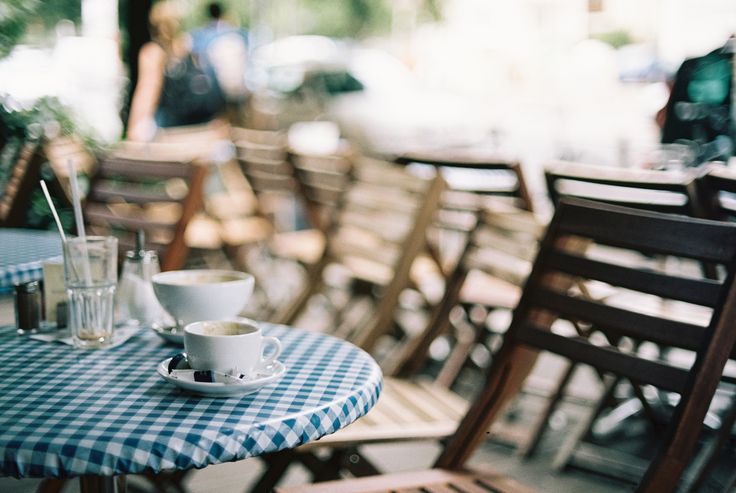
The Café Fleury is covered in scaffolding by mid-summer, caused by the building works happening on the upper levels. White sheets are draped over the scaffolding, and it looked like a haunted house. There were three couples on the tables next to mine, and all of them were smiling and beautiful. So was the woman across from me, but this was not a date, and unlike the others, she hadn’t smiled in several months.
“Thank you for agreeing to meet with me,” she said.
“It’s not an inconvenience at all,” I said.
“No, really.”
Her name was Olga, and when she first contacted me online, I told her that I was in the process of deleting these dating apps and moving overseas, and that now was probably not the best time to start dating someone new.
“That’s okay, I’m not looking for a date. Just a conversation to fill the time.”
“How long are you going to be in Berlin?” I asked.
“Only two days, so tonight is best. Then I’m going back to continue reporting on the war effort,” she said.
At the café, she leant back from the table, showing off her bright blue summer dress, with the buttons slightly undone in the front, to reveal her pale white skin. It was not exactly sexually provocative. It was for the heat. Above the blue dress sat golden hair, and the contrast was reminiscent of the flag of her people.
“Do you want an English menu?” the waiter asked us.
I shook my head no.
“I’ll have a cappuccino. And you?” I said.
“Yes, a Chai,” she said.
The waiter left us.
“Your English is excellent,” I said.
She blushed furiously red and shook her head no. “I know nothing, but we used to watch movies in English back home. British humour is my favourite.”
“Dr. Who?” I asked.
“My favourite!” she said, beaming, then mimicking a robot.
I nod as if I know what she’s talking about.
The chai arrived, and the coffee, and she dunked her teabag multiple times, looking down at the water and refusing to make eye contact. There was a slight shake in her fingers and wrist, but it was only noticeable if I paid any attention to it.
She took the teabag carefully out and rested it on the saucer. I’m reminded of an article I read once about how teabags now contain microplastics. They used to be made of silk, and now they’re made of plastic, because of cost cutting or something like that. Microplastics will apparently kill us all one day, or are already killing us, I forgot which, because I’d already forgotten the article.
“This is a lovely place,” she said, but her eyes flickered past me whenever a siren sounded, or a dog barked, or the waiter dropped a glass to the ground, which was surprisingly often.
A large dog growled next to us, and she flinched away, like it was the clash of a cymbal or a Chinese gong, then looked back up at me shyly.
“All is good?” I said.
She burst out laughing.
“You are becoming German,” she said, and repeats, “Alles ist gut? Ya, ya. Gut! Danke!”
“Gut!” I said.
I smiled shyly and sipped my coffee.
“What do you think about Germany?” I asked.
“It’s warmer than I expected. Although most places are warmer than home. I do miss home though…” she trailed off, “I’m a TV reporter, you know, and I started just before the war and…”
She stopped mid-sentence, swept a single strand of hair out of her eyes and drank some of her Chai.
“Do you like it here?” she said.
“I love it in Berlin, but I’m not precise enough to live in Germany.”
“What does that mean?” she asked.
“I speak very vaguely, and people don’t like that.”
Her eyes squinted at me.
“For example?”
“For example, I’m learning to ride a bicycle, and my instructor is from Hamburg. I told her, ‘I’m going to visit Hamburg by the sea,’ and she said, ‘No, you are going to visit Hamburg by the harbour.’ Five minutes later, I told her, ‘Can I help you take the bicycles back to the train station?’ and she said, ‘No, you can help me take the bicycles back to the bike rack’.”
Her laughter was a sharp sound that shattered the quiet of the café, and it came from somewhere deep inside of her chest. Her eyes went wide behind her glasses, as if realizing something new. But she didn’t tell me what the new thing was.
“That’s funny,” she says, then pauses, “You know I haven’t laughed this much since the start of the war.”
“I’m sorry.”
“No. It means a lot to me that you can help me forget for a moment, to take me somewhere else… I’m sorry, I don’t mean to bring it up so often.”
I shake my head.
“No, go on.”
“It’s just strange to think of all those places being gone. My grandparent’s farm… I was just there a few months ago, and now it’s not there anymore. I don’t know what it means when something disappears from the world. Now, it is only in here.”
She pointed to her head, and went silent for a long while.
“Have you met any Russians?” she said, suddenly.
“I’ve met a few. Only the younger ones though, who don’t agree with the current government.”
She waited for me to continue.
“They are stuck here. They will never go back home, from what I understand. They do their best to welcome refugees. I’ve not met the older generation.”
“You are lucky then,” she said, then after a moment added, “There are evil people everywhere.”
“There are evil people everywhere.”
That caused an even longer silence, as we both sipped our respective drinks.
“I will teach you some Ukrainian words,” she said, suddenly making eye contact, “Pryvit means hello.”
“I know that one.”
“Dyakuyu means thank you.”
“Dyakuyuuuuu,” I say.
She laughs and nods.
“Yes. You’re very good at the pronunciation.”
“I’m terrible at languages.”
“No really.”
“Can you tell me about your home?”
She spoke for a long time about it, and her eyes flickered with memories dancing along her pupils.
“I probably won’t be back for a long time, but if you’re still in Germany after the war,” she said, shrugging her shoulders.
“If I’m still in Germany,” I said, in agreement.
She thanked me for the chat, and we paid, and I couldn’t help but think about people back home in Sydney, who act cruel and vindictive for much fewer, pettier reasons, and who destroy the lives of others out of the vague excuse of once having suffered themselves, while ultimately merely adding more suffering to the world.
In Olga, here was someone different. In the most trying of circumstances, she remembered beauty. The beauty of the world before the war, how the butterflies rested on her fingertips as a kid on her grandparent’s farm, how the tulips looked in full bloom, and the ocean swell, and the moon – the days spent horse riding in the meadows, and the mountain roads, and the poetic pronunciation of the Ukrainian language as it left her lips and entered the world afresh like a newborn lamb.
Yes, beauty. Real live beauty. And the feeling of graduation, and that photo exhibition, and those long lines out by the sea, once upon a time when Ukraine had a sealine and time and space enough to breathe.
And despite her comment, it made me think that there were good people everywhere too, and that I had just met one of them.
This is part of a short zine of mine titled: Love, Travel and Italian Wine.
This short publication is now available for pre-order on Amazon.
In Love, Travel and Italian Wine, the European continent comes alive in gripping vignettes, flash fiction and poetry, with each story like something out of a dream. In a journey to discover art, poetry, music, literature and philosophy in the humble beauty of graffiti sprayed onto canal-side walls, the protagonist learns to resuscitate his dying creative embers from the ashes, to see the world anew, and to discover a new way to live. From the slow meandering of an afternoon in Rome, to the rush of a Berlin nightclub to a conversation in a quiet café with a Ukrainian refugee, the book unveils a nuanced picture of Modern Europe, and is equal parts travel diary, poetic self-discovery and photo essay.


 New Intrigue
Leave a Reply